Browse the most up to date, fastest production Corvettes, Mustangs and Camaro's by make, model and modifications on 1/8th mile and 1/4 mile drag strips. Submit your ticket and get listed.
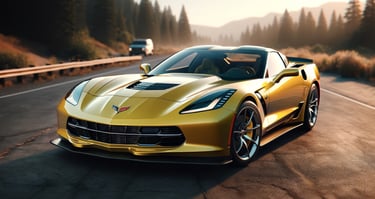
The Chevrolet Corvette, one of America's most iconic sports cars, has seen significant evolution through its generations, notably the C6 (2005-2013), C7 (2014-2019), and the C8 (2020-present). Each generation has brought with it substantial improvements in technology, design, performance, and driving dynamics. Let's compare these three generations in terms of performance and quarter-mile times (ET times) to highlight their differences and advancements.
C6 Corvette (2005-2013)
The C6 Corvette continued the front-engine, rear-wheel-drive layout but with a more refined package than its predecessor. Its design was more streamlined, featuring exposed headlights for the first time since 1962. The standard C6 came equipped with a 6.0L LS2 V8 engine, producing 400 horsepower and 400 lb-ft of torque, later updated to a 6.2L LS3 in 2008, pushing power to 430 hp. The Z06 model, a performance variant, boasted a 7.0L LS7 V8 with 505 hp. Notably, the ZR1 version introduced in 2009, came with a supercharged 6.2L LS9 V8, delivering 638 hp.
Standard C6: 0-60 mph in about 4.2 seconds, quarter-mile in around 12.4 seconds.
Z06: 0-60 mph in 3.7 seconds, quarter-mile in approximately 11.7 seconds.
ZR1: 0-60 mph in 3.4 seconds, quarter-mile in about 11.2 seconds.
C7 Corvette (2014-2019)
The C7 marked a substantial leap forward in terms of design, technology, and performance. The Stingray base model was powered by a new 6.2L LT1 V8 engine, producing 455 hp (460 hp with the performance exhaust). The Grand Sport and Z06 variants further pushed the envelope; the Z06 featured a supercharged 6.2L LT4 V8 with 650 hp and 650 lb-ft of torque. The pinnacle of C7 performance was the ZR1, introduced in 2019, with a supercharged 6.2L V8 pushing 755 hp.
Stingray: 0-60 mph in 3.7 seconds, quarter-mile in around 11.9 seconds.
Z06: 0-60 mph in 2.95 seconds, quarter-mile in approximately 10.95 seconds.
ZR1: 0-60 mph in 2.85 seconds, quarter-mile in about 10.6 seconds.
C8 Corvette (2020-Present)
The C8 Corvette represented a revolutionary change with its mid-engine layout, drastically improving weight distribution, handling, and acceleration. The base model, the Stingray, is powered by a 6.2L LT2 V8 engine producing 490 hp (495 hp with the performance exhaust), and it's the first Corvette to offer an 8-speed dual-clutch transmission. The performance leap is significant, with improved traction and dynamics thanks to its mid-engine design.
Stingray: 0-60 mph in 2.9 seconds, quarter-mile in around 11.2 seconds.
Performance times for the C8 Z06, which uses a flat-plane crank 5.5L V8 producing 670 hp, and any future variants have yet to be fully detailed but promise to push these numbers even further.
Comparison and Evolution
Across these three generations, the Corvette has consistently moved towards better performance and more sophisticated engineering. The transition from the C6 to the C7 brought notable improvements in technology and power. However, the move from a front-engine (C7) to a mid-engine layout (C8) represents the most significant evolutionary leap, offering superior handling, balance, and acceleration.
The C8's performance, even in its base model, rivals that of the much more powerful versions of the C6 and C7, demonstrating how transformative the new mid-engine layout and modern engineering approaches have been for the Corvette's performance capabilities.
Each generation reflects Chevrolet's commitment to pushing the boundaries of American sports car performance, with the C8 opening a new chapter that promises to elevate the Corvette's status further among the world's best sports cars.
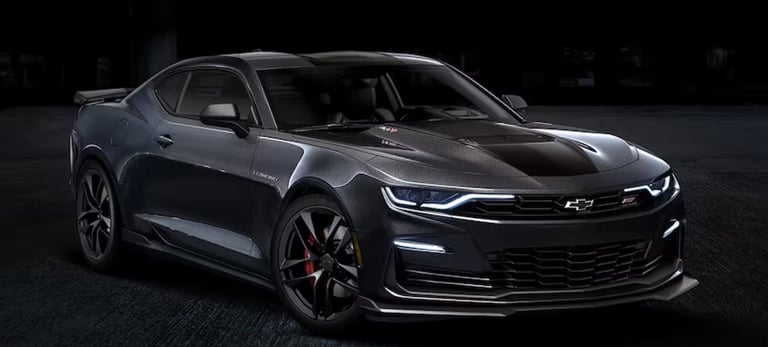
The Chevrolet Camaro, a cornerstone of American muscle car culture, has undergone significant transformations through its production life. Particularly, the 5th (2010-2015) and 6th (2016-present) generations mark notable advancements in performance, technology, and design. Here, we'll explore these two generations to understand their differences in performance and quarter-mile (ET) times.
5th Generation Camaro (2010-2015)
The 5th generation marked the return of the Camaro after an 8-year hiatus, featuring a retro-inspired yet modern design. This generation was introduced with a variety of engine options, ranging from a 3.6L V6 in the base model to a 6.2L V8 in the SS model, and culminating in the ZL1's supercharged 6.2L V8.
- LS/LT (V6): The base models came with a V6 engine producing up to 323 hp by the end of the generation, capable of reaching 0-60 mph in about 5.9 seconds, with quarter-mile times in the high 14-second range.
- SS: Equipped with a 6.2L V8, the SS model produced 426 hp (manual) or 400 hp (automatic), achieving 0-60 mph in around 4.7 seconds and quarter-mile times in the low 13-second range.
- ZL1: The high-performance ZL1, introduced in 2012, featured a supercharged 6.2L V8 with 580 hp, accelerating from 0-60 mph in 3.9 seconds and running the quarter-mile in about 12 seconds.
6th Generation Camaro (2016-Present)
The 6th generation Camaro brought substantial improvements in performance, handling, and technology, riding on GM's lighter and more sophisticated Alpha platform. The redesign included more powerful and efficient engine options, a refined interior, and enhanced driving dynamics.
- LT (V6): The updated 3.6L V6 engine now produces 335 hp, capable of 0-60 mph in around 5.1 seconds, with quarter-mile times in the mid 13-second range.
- SS: The SS model received a new 6.2L LT1 V8, derived from the Corvette, producing 455 hp. This model can accelerate from 0-60 mph in about 4 seconds, with quarter-mile times in the high 12-second range.
- ZL1: The latest ZL1 features a supercharged 6.2L LT4 V8 with 650 hp, matching the Corvette Z06. It can sprint from 0-60 mph in 3.5 seconds and complete the quarter-mile in about 11.4 seconds.
Comparison and Evolution
Transitioning from the 5th to the 6th generation, the Camaro has seen enhancements across the board. While the 5th generation resurrected the Camaro nameplate with a strong foundation of performance and style, the 6th generation refined and advanced these aspects to new levels. Notably, the 6th generation benefits from significant weight reductions, more powerful engine options, and an improved chassis, contributing to better handling, faster acceleration, and quicker quarter-mile times.
The 6th generation's engines, especially the SS and ZL1 variants, exhibit a marked improvement in performance, rivaling and in many aspects surpassing, not just their predecessors but also competing muscle and sports cars. Moreover, the introduction of advanced driver aids, improved interiors, and better overall refinement make the 6th generation Camaro a more complete package, blending muscle car rawness with contemporary sports car sophistication.
In summary, the evolution from the 5th to the 6th generation Camaro illustrates Chevrolet's commitment to advancing performance and driving experience. Each generation builds on the legacy of the Camaro, with the latest generation setting high benchmarks for power, speed, and agility in the muscle car segment.