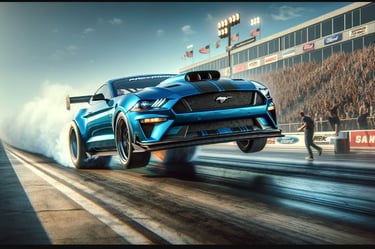
Browse the most up to date, fastest production Corvettes, Mustangs and Camaro's by make, model and modifications on 1/8th mile and 1/4 mile drag strips. Submit your ticket and get listed.
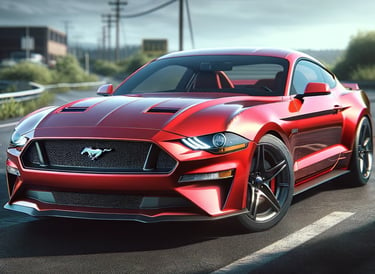
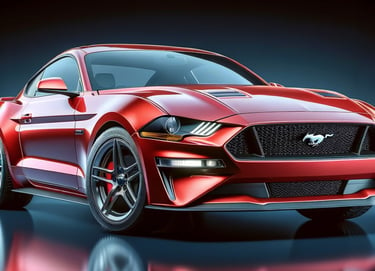
When comparing the performance of the fifth, sixth, and latest seventh-generation Ford Mustangs, we're delving into the evolution of one of the most iconic American sports cars. Each generation has brought its own advancements, design philosophies, and performance enhancements, reflecting Ford's response to market demands and technological progress.
Fifth Generation (2005-2014)
The fifth-generation Mustang marked a return to its roots with a retro-inspired design that echoed the 1960s models. Performance-wise, the introduction of this generation saw a significant upgrade from its predecessors. The base model initially featured a 4.0L V6 engine producing 210 horsepower, while the GT version boasted a 4.6L V8 with 300 horsepower. Over the years, Ford introduced several high-performance variants, such as the Shelby GT500, equipped with a supercharged 5.4L V8 capable of 500 horsepower in early versions, which was later upgraded to 662 horsepower in the 2013-2014 models.
Sixth Generation (2015-2021)
The sixth-generation Mustang brought significant technological and engineering improvements, offering better performance, handling, and efficiency. It introduced a new independent rear suspension system, replacing the older solid rear axle, which significantly improved the car's handling and ride quality. The base engine was a more efficient 3.7L V6 with 300 horsepower, but the real game-changer was the introduction of a 2.3L EcoBoost turbocharged four-cylinder engine, producing 310 horsepower and offering a compelling mix of performance and fuel economy. The GT model featured an upgraded 5.0L V8, pushing out 435 horsepower. Special editions like the Shelby GT350 and GT350R, with their 5.2L V8 producing 526 horsepower, focused on track-oriented performance.
Seventh Generation (2022-Present)
The latest, seventh-generation Mustang continues to push the envelope in terms of performance and technology. Ford has retained the beloved 5.0L V8 for the GT models, now producing over 450 horsepower, and the 2.3L EcoBoost engine, which has been further refined for efficiency and performance. A major highlight is the reintroduction of high-performance variants like the upcoming GT500, details of which are eagerly anticipated by fans and enthusiasts. This generation also benefits from advanced technology, including digital instrument clusters, driver assistance features, and improved chassis and suspension design, making it the most refined Mustang to date.
Comparison and Conclusion
Comparing the three generations, it's clear that Ford has continuously evolved the Mustang to offer more power, better handling, and advanced technology with each new iteration. The fifth generation revived the Mustang's classic appeal, the sixth generation introduced significant technical advancements, and the latest generation builds on this legacy with even more power and cutting-edge features. Each generation has its charm and appeal, but the latest Mustang stands out as the most technologically advanced and performance-oriented version, offering a blend of traditional muscle car power with modern efficiency and driving dynamics. Whether for daily driving or track performance, the Mustang continues to symbolize American automotive passion and innovation.